From Rumble to Sensory Gameplay: How Touch Is Changing the Way Games Communicate
Admin Wyvrn · · Haptic Technology
Games have always spoken to players through visuals and sound. Now, touch is becoming part of that language. This article looks at how HD haptics, full-body feedback, and adaptive systems are changing the way games communicate with players.
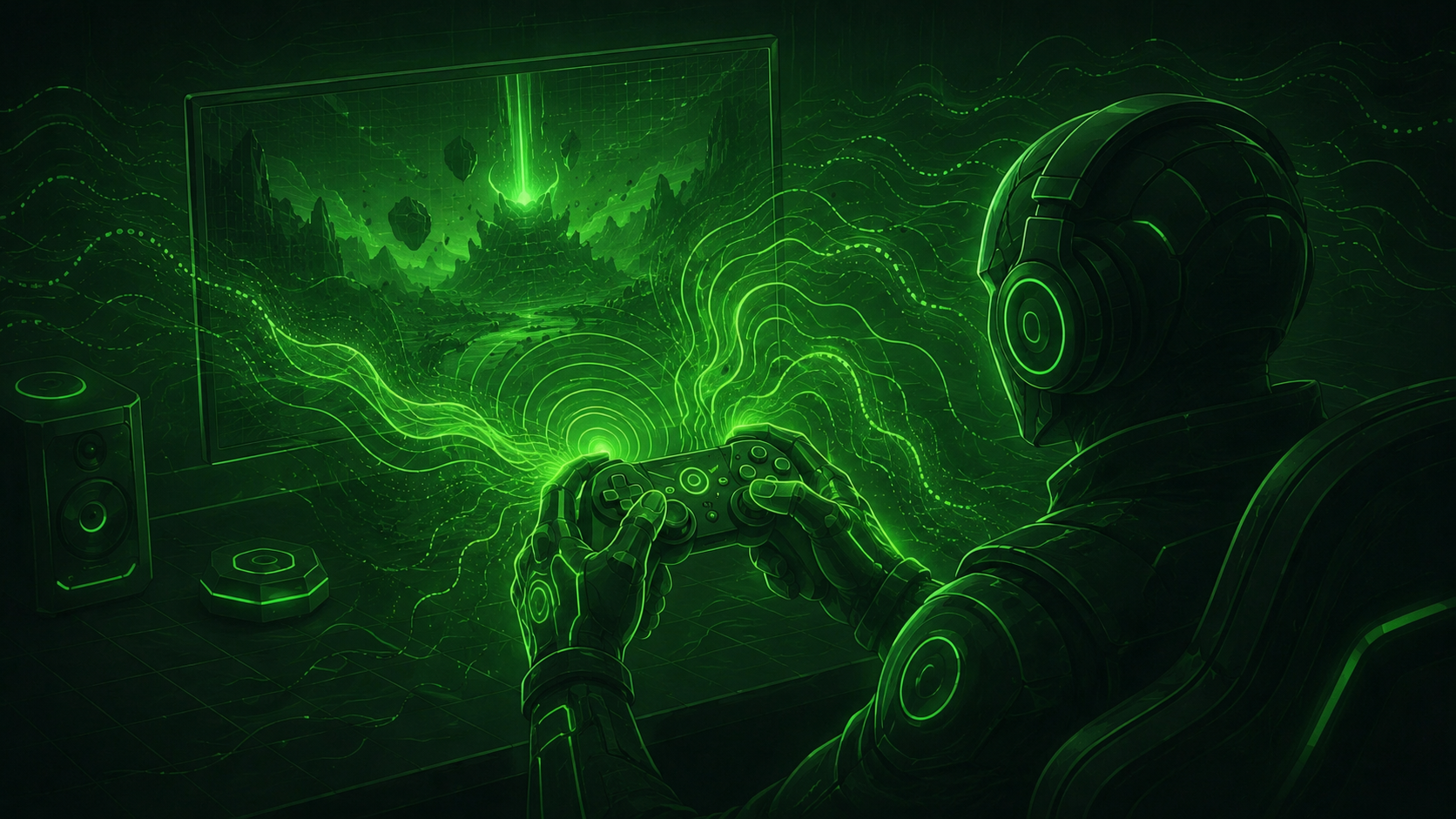
For years, “vibration” in games was treated as a simple add-on—useful, but rarely essential. Today, that has fundamentally changed. HD haptics have turned touch into a much more expressive sensory channel. They can now communicate texture, direction, impact, and even emotion—things visuals and audio alone struggle to convey.
So what is the real difference between traditional rumble and HD haptics? Rumble is usually broad and blunt. HD haptics, by contrast, deliver diverse, layered, and clearly readable sensations. They feel intentional, not generic.
Haptics is now moving from a peripheral effect to a core part of immersive game design, especially as tactile feedback is increasingly combined with spatial audio for games and ambient lighting. To understand why this matters, it helps to look at how haptics evolved — and where they are going next.
How Haptics Evolved from Simple Rumble to HD Feedback
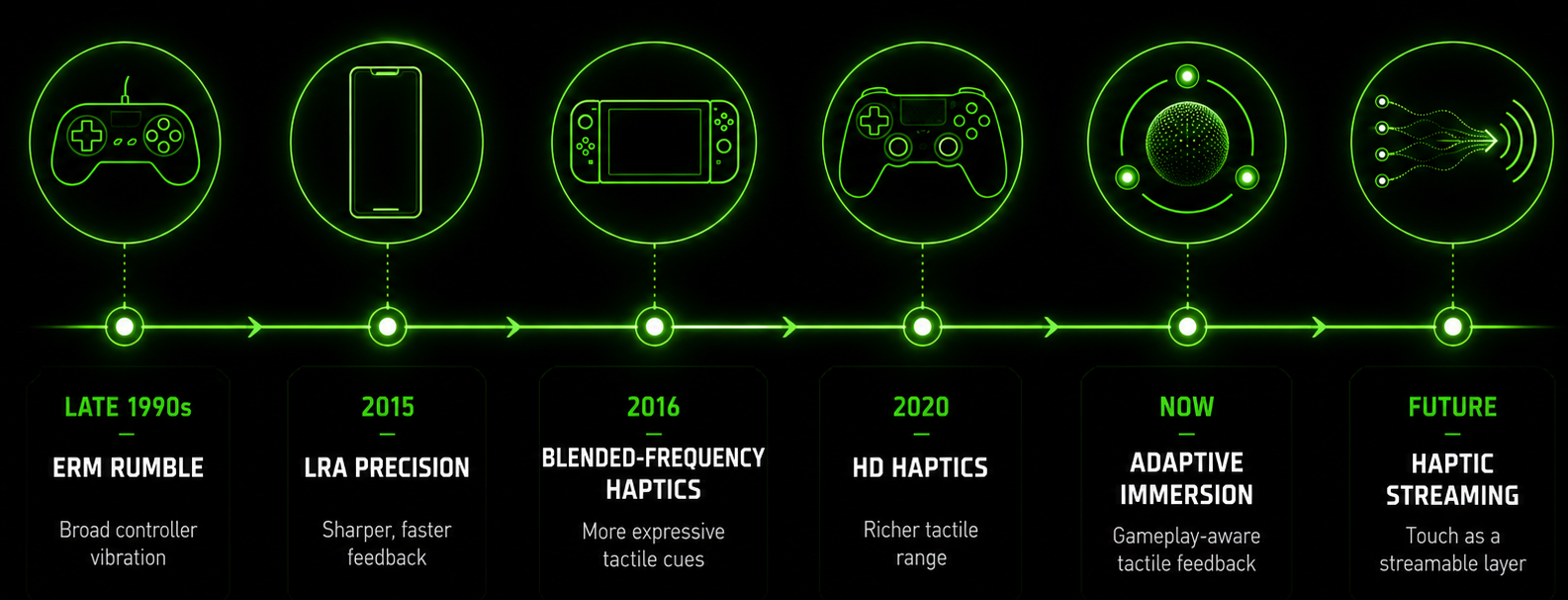
Early gaming haptics date back to the late 1990s, with devices like the Nintendo Rumble Pak and the first DUALSHOCK controllers. These systems relied on eccentric rotating mass motors, or ERMs: small motors that spin an off-center weight to create vibration.
ERMs are inexpensive and effective at producing broad rumble effects, such as explosions, collisions, or danger signals. But they come with clear limitations. Because the motor needs time to spin up and slow down, ERMs struggle with fast, precise, or highly varied feedback. A gunshot, a surface texture, or a sharp directional cue can easily become the same generic buzz.
A major shift began in 2015 with the introduction of linear resonant actuators (LRAs) in smartphones. LRAs respond faster than ERMs and are better at producing crisp, precise signals —like simulating a mechanical click. This explains why modern phone haptics often feel sharper than older controller vibration.
But LRAs also have limits. They usually work best around a fixed resonance frequency, which can make feedback feel repetitive or buzzy over time. That is useful for confirmation feedback, but less effective when the goal is deep, varied immersion.
In 2016, the Nintendo Switch showed a different direction with blended-frequency haptics. While not fully wideband, it demonstrated that haptics could communicate more than intensity alone. Its well-known “ice cube” demo, where players could feel virtual cubes moving inside the controller, showed that haptics could also communicate movement, material, and presence.
The real breakthrough arrived in 2020 with the DualSense controller from PlayStation. By combining force feedback with wideband voice-coil actuators, it introduced what we now call HD haptics.
Wideband systems can generate a much wider range of tactile frequencies and patterns. Instead of one vibration signal, developers can create nuanced sensations that are easier to distinguish from one another. This gives touch a richer vocabulary: rain can feel different from sand, recoil—from an engine, and impact can carry direction as well as force.
This matters because touch is the fastest human sense. Even very small delays can make an interaction feel wrong. Fast actuation is therefore not just a technical upgrade. It is what makes haptic feedback believable.
For a quick visual breakdown, check out our infographics on the evolution of haptics.
For a quick visual breakdown, check out our infographics on the evolution of haptics.
Why Do HD Haptics Matter for Players and Studios
For studios, the question is simple: do HD haptics improve player experience in a meaningful way?
When designed well, they do. Good haptics make interactions feel more physical, more responsive, and more memorable. They can improve the first impression of a game when the experience is played as intended. And a strong first impression drives better reviews, wider coverage, and higher player retention —key contributors to long-term commercial success.
When designed well, they do. Good haptics make interactions feel more physical, more responsive, and more memorable. They can improve the first impression of a game when the experience is played as intended. And a strong first impression drives better reviews, wider coverage, and higher player retention —key contributors to long-term commercial success.
This does not mean haptics are equally important in every genre or for every player. Competitive esports players may reduce or disable vibration to avoid distraction and prioritize performance. But in action, adventure, horror, racing, simulation, and narrative-driven games, HD haptics can significantly increase engagement.
A strong example is Astro Bot on PlayStation 5. What began as a showcase for the DualSense controller evolved into a full game where haptics are deeply embedded in gameplay mechanics. This answers an important design question: can haptics be more than a presentation layer?
In this, and many other cases, yes. The experience simply does not function the same way without them. HD haptics become part of the game’s language itself.
Another important dimension to consider is accessibility. Because wideband haptics can reinforce rhythm, impact, direction, and intent, they can support players who rely less on audio cues. For players with hearing impairments, carefully designed haptic patterns can offer another way to understand what is happening in the game.
That makes haptic feedback a useful communication layer, not only a sensory enhancement.
From Handheld Feedback to Full-Body Immersion
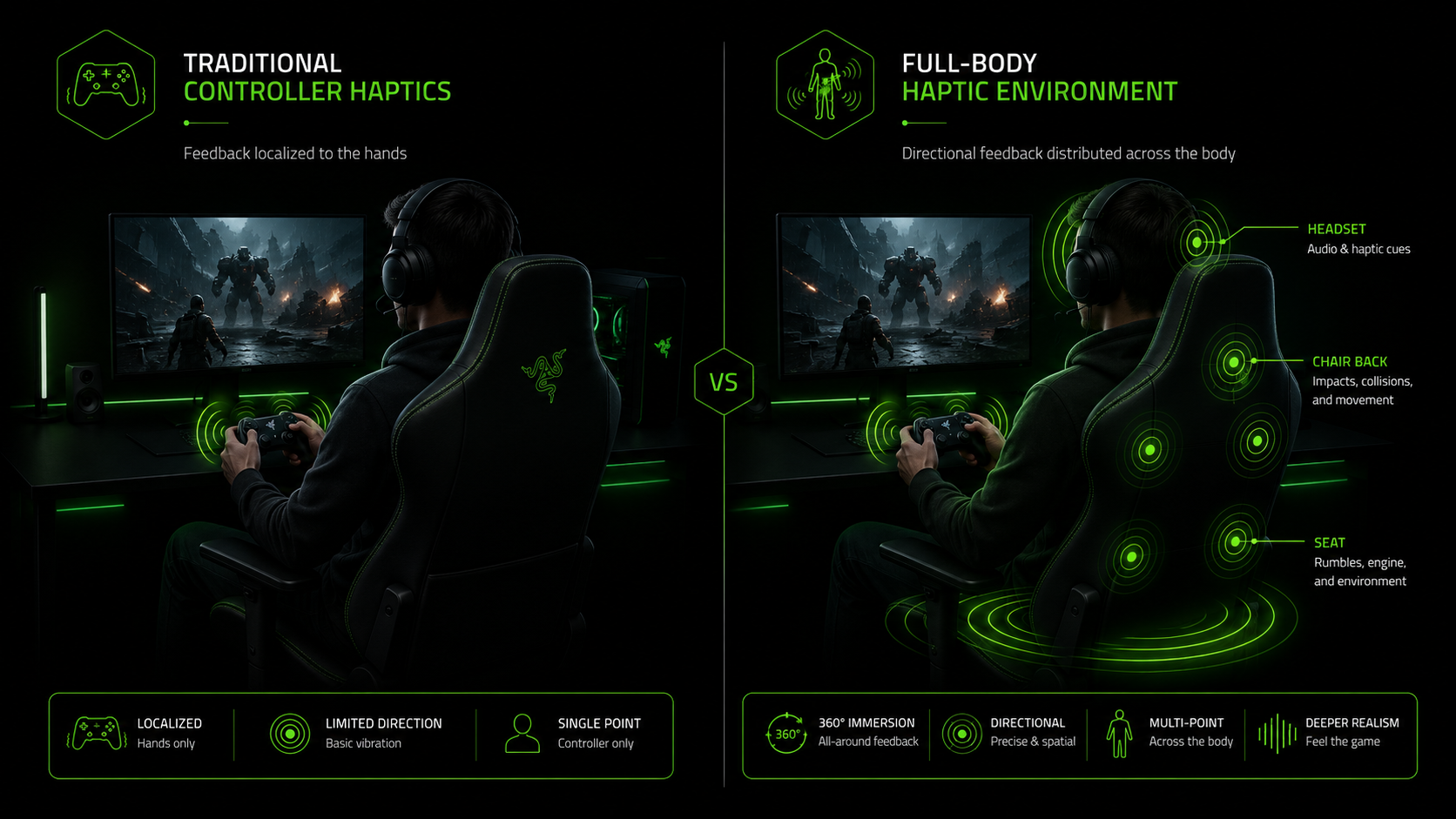
HD haptics in controllers are powerful, but they are inherently limited to the hands. This leads to a natural next step: how do you make haptics feel environmental rather than localized?
This is the direction behind Razer Sensa HD Haptics. Instead of treating haptics as a feature locked to one device, Razer Sensa brings wideband tactile feedback into the wider gaming setup: chairs, headsets, controllers, and other peripherals players already use.
The result is a multi-directional, full-body 3D haptic environment. Sensations are no longer reduced to a single vibration source. They are distributed around the player.
In practical terms, this means players can feel where something happens: left, right, behind, below, or across the body. The effect is similar to how surround sound places audio in space.
This is why the idea is sometimes described as “Dolby Atmos for touch.” The key shift is directionality. Feeling an impact behind you or terrain changing beneath you creates a different level of physical presence and emotional response. This approach is especially relevant for action, horror, and racing games. The value is not only stronger feedback. It is more believable feedback.
Why Synchronizing Haptics, Audio, and Lighting Matters
Haptics become even more powerful when they are not working alone. The strongest immersive experiences happen when touch, sound, and light reinforce the same in-game event.
Modern multisensory game systems can combine three layers:
• HD haptics for tactile feedback
• spatial audio for accurate 3D sound positioning
• ambient RGB lighting for peripheral visual cues
Each layer plays a different role. Haptics provide physical sensation. Spatial audio gives direction and distance. Lighting extends the moment into the player’s peripheral vision.
Each layer plays a different role. Haptics provide physical sensation. Spatial audio gives direction and distance. Lighting extends the moment into the player’s peripheral vision.
Ambient lighting has also evolved beyond simple reactive effects. It can now form spatial lighting environments, where individual LEDs respond to in-game movement, collisions, explosions, or atmosphere. When used carefully, lighting does not distract from gameplay. It reinforces motion, intensity, and mood around the screen.
Spatial audio adds another layer of coherence. It can express height, depth, and direction in ways that align closely with haptic feedback. When audio, haptics, and lighting follow the same spatial logic, the result feels intentional rather than overwhelming.
And this is the real challenge of multisensory design. More feedback does not automatically mean better immersion. If every system reacts loudly to every event, the experience becomes noisy. The best systems allow developers to tailor intensity by genre or mode. Players also need control, so they can tune the experience to their own comfort level. Immersion only works when it supports the game instead of competing with it.
The Next Step: Adaptive Immersion for Gameplay-Aware Feedback
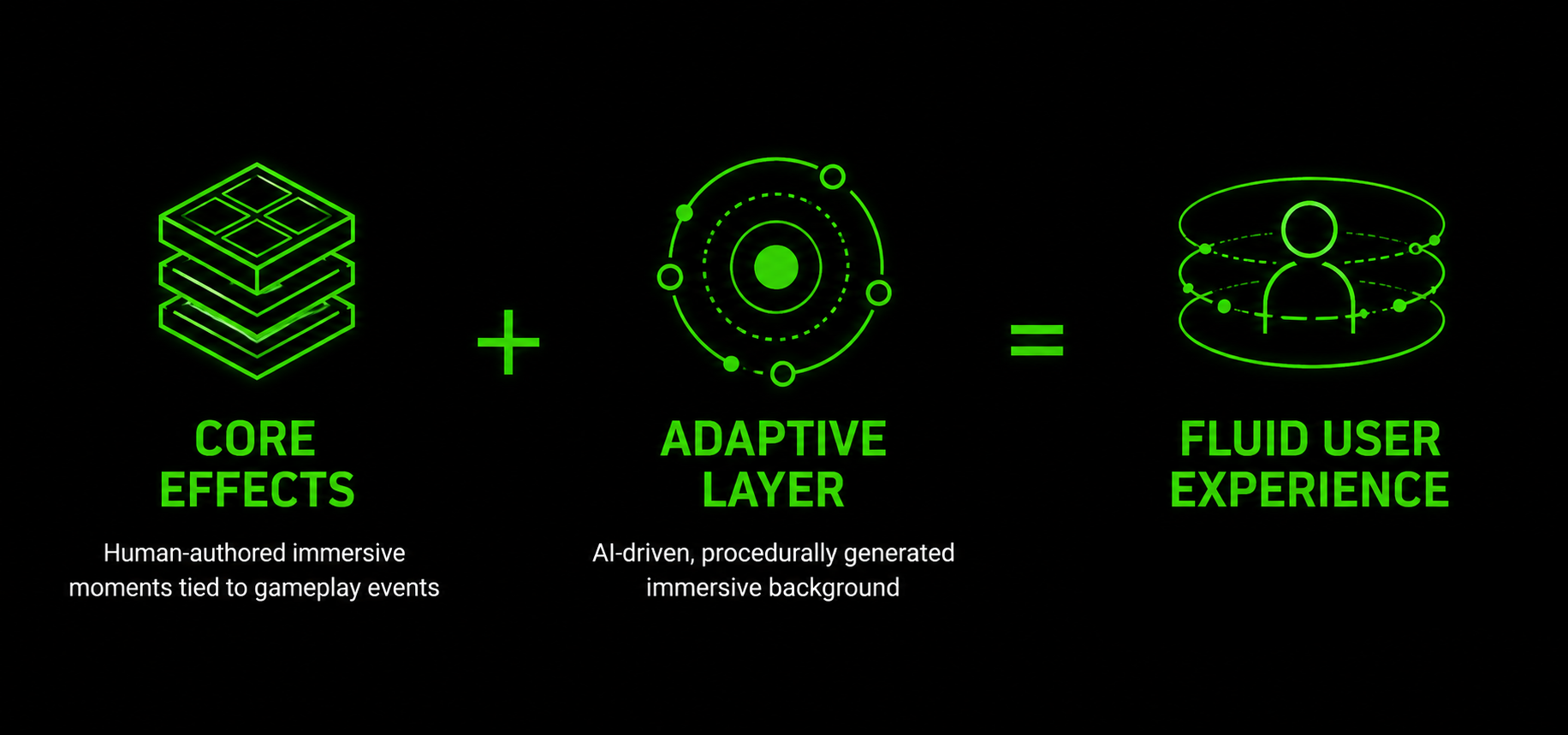
The next stage of immersive design is not simply adding more effects. It is making those effects smarter.
Today, many haptic and lighting are still authored manually. Developers decide what should happen, when it should happen, and how it should feel. This gives creative control, but it can also be time-consuming and difficult to scale across large games.
Adaptive immersion points to a more dynamic model. Instead of relying only on pre-authored effects, adaptive immersive systems can respond to gameplay context in real time. They can interpret what is happening on screen, understand the intensity of the moment, and generate feedback that fits the experience as it unfolds.
The result is an experience that feels less scripted. Touch and light become more responsive to the game itself — not just to a fixed set of triggers prepared in advance.
The Future: Streaming the Touch
The next major shift is haptic streaming.
As standardized haptic encoding develops, touch is beginning to move toward the same model as audio and video: a streamable media layer. Instead of treating haptics as local effects stored inside a game or device, tactile signals can be encoded, transmitted, and played back in sync with the rest of the experience.
In practical terms, haptic streaming allows touch data to travel alongside audio and video streams. When a compatible device receives the stream, it reconstructs the tactile output and renders it in time with the media signal.
This matters because haptics require very little bandwidth compared with video, but can add a significant layer of presence. A live broadcast impact, an explosion in streamed content, or the changing surface of a racing track could all be delivered as part of the media experience, not added separately afterward.
What This Means for the Next Generation of Games
The most interesting consequence is that developers gain new ways to shape player perception without adding more UI, dialogue, or visual noise. A game can now communicate at a different level, speaking directly to the player’s senses. That matters because modern games are already dense with information. The next step is not about adding more effects. It is about helping players understand and experience more with less friction.