The Current State of Game QA: Challenges, Bottlenecks, and Future Needs
Sergio Schiavo · · Game QA
As systems multiply and production accelerate, manual testing alone struggles to scale, leading to QA debt, late performance issues, and lost engineering time. The industry is now shifting toward AI-assisted QA to capture better context, surface issues earlier, and help teams ship with confidence, without replacing human judgment.
Game development has never been more ambitious — or more fragile.
Modern games are larger, more systemic, more connected, and expected to run flawlessly across an ever-growing matrix of platforms and hardware. Yet despite massive advances in engines, tooling, and production workflows, quality assurance in game development remains a consistently challenging part of the pipeline.
This isn’t because QA teams aren’t working hard. It’s because the nature of game QA has fundamentally changed, while most QA tools and processes have not kept pace.
Modern games are larger, more systemic, more connected, and expected to run flawlessly across an ever-growing matrix of platforms and hardware. Yet despite massive advances in engines, tooling, and production workflows, quality assurance in game development remains a consistently challenging part of the pipeline.
This isn’t because QA teams aren’t working hard. It’s because the nature of game QA has fundamentally changed, while most QA tools and processes have not kept pace.
Modern Game Complexity vs. Traditional QA Processes
Today’s games are no longer a collection of isolated levels and mechanics. They are system-driven, content-heavy, and performance-sensitive, often spanning PC, console, and mobile platforms simultaneously. They are built on engines like Unity and Unreal that evolve continuously, alongside proprietary and legacy technology.
Each new feature adds exponential interactions. Every optimization risk regression elsewhere. While many studios have evolved their QA practices alongside growing complexity, QA remains deeply rooted in hands-on testing, exploratory play, and team knowledge. As games scale, teams are now looking to augment these workflows to extend coverage and reduce risk without losing the strengths of human-led QA.
That mismatch is at the heart of the problem.
Each new feature adds exponential interactions. Every optimization risk regression elsewhere. While many studios have evolved their QA practices alongside growing complexity, QA remains deeply rooted in hands-on testing, exploratory play, and team knowledge. As games scale, teams are now looking to augment these workflows to extend coverage and reduce risk without losing the strengths of human-led QA.
That mismatch is at the heart of the problem.
Why Manual Game QA Doesn’t Scale
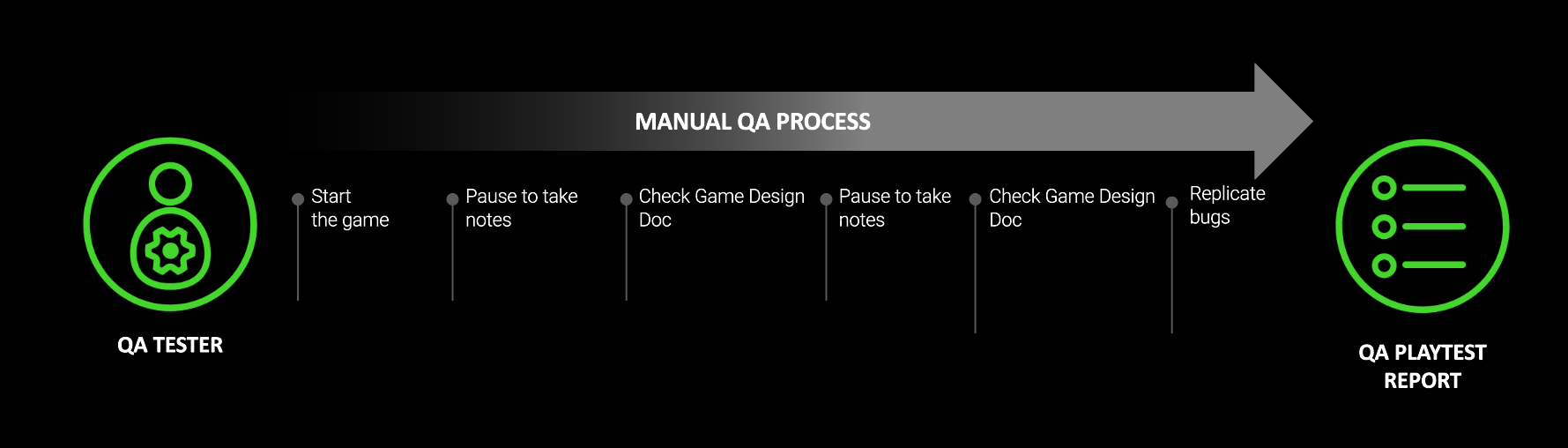
Manual QA is essential, but it does not scale efficiently.
For decades, game QA has relied on human intuition, experience, and exploration. Skilled testers are exceptionally good at spotting issues that automated tests will never catch: broken flows, unclear feedback, “this just feels wrong” moments. That human judgment remains irreplaceable.
The problem isn’t manual testing itself.
The problem is asking manual QA to shoulder problems it was never designed to solve at today’s scale.
As games grow more complex, the surface area for bugs expands, making it increasingly challenging to cover through playtesting alone. Each new system introduces additional interactions, and every new build increases the need for systematic regression testing to ensure nothing breaks elsewhere.
For decades, game QA has relied on human intuition, experience, and exploration. Skilled testers are exceptionally good at spotting issues that automated tests will never catch: broken flows, unclear feedback, “this just feels wrong” moments. That human judgment remains irreplaceable.
The problem isn’t manual testing itself.
The problem is asking manual QA to shoulder problems it was never designed to solve at today’s scale.
As games grow more complex, the surface area for bugs expands, making it increasingly challenging to cover through playtesting alone. Each new system introduces additional interactions, and every new build increases the need for systematic regression testing to ensure nothing breaks elsewhere.
1. QA Debt Builds Up in Fast-Moving Game Production
As production accelerates, test coverage rarely keeps pace. Teams prioritize validating new features while older systems quietly degrade. Bugs don’t disappear; they get deferred, duplicated, or rediscovered later under pressure.
Over time, this creates QA debt: unresolved issues, untested paths, and fragile builds that become increasingly difficult to reason.
Over time, this creates QA debt: unresolved issues, untested paths, and fragile builds that become increasingly difficult to reason.
2. The Reproducibility Problem in Game QA
Many bugs are found once and never reliably reproduced. Test reports often rely on vague descriptions like “happened after 30 minutes of play” or “only on this build, once.”
Without precise context, such as inputs, timing, performance state, or system load, engineers spend hours chasing issues that may already be gone. QA becomes a bottleneck not because of volume, but because of ambiguity.
Without precise context, such as inputs, timing, performance state, or system load, engineers spend hours chasing issues that may already be gone. QA becomes a bottleneck not because of volume, but because of ambiguity.
3. Inconsistent Test Coverage in Manual Game Testing
Even with strong test plans, coverage still depends heavily on who tested the build, what they focused on, and how much time they had. Two testers can play the same build and surface entirely different issues. Over time, this leads to blind spots, particularly in long-session behavior, edge cases, and gameplay performance testing. Manual coverage alone cannot reliably track FPS drops, CPU spikes, or memory regressions across repeated play sessions.
4. Fragmentation Across QA Tooling and Data
Many studios rely on a mix of engine-native tools, internal workflows, and, at times, external QA partners. As teams grow, test results, bug reports, and crash data naturally spread across different tools and formats. Over time, this can make it harder to compare builds, follow regressions, or keep everyone aligned on the state of quality. In that context, a unified QA data layer—one that brings together crash data from engines like Unity or Unreal alongside existing test signals—becomes increasingly valuable as QA scales.
5. Gameplay Performance Issues Are Detected Too Late
Frame drops, memory spikes, and stability regressions often surface late in development, after content lock, or worse, during certification. By that point, the cost of fixing them is high, and trade-offs become unavoidable. Performance QA is rarely continuous — it’s reactive.
The Hidden Cost of Inefficient Game QA: Lost Engineering Time
Every unclear bug report, missing reproduction step, or late discovery carries a downstream cost.
Engineers lose time asking follow-up questions, attempting to reproduce unclear issues, investigating false positives, and context-switching instead of building features. The result is not just longer QA process, but slower development across the entire studio.
Engineers lose time asking follow-up questions, attempting to reproduce unclear issues, investigating false positives, and context-switching instead of building features. The result is not just longer QA process, but slower development across the entire studio.
What Game Studios Need From Modern QA Tools
Across teams of all sizes, the same needs keep coming up:
- More consistent QA output
- Earlier detection of issues
- Faster validation of builds
- Less noise, fewer duplicates
- Better context for engineering
- Confidence that a build is “safe enough” to move forward
Small QA teams are increasingly expected to deliver the output of much larger studios, without proportional increases in headcount or budget.
Something has to change.
Something has to change.
The Shift Toward Automated and AI-Assisted Game QA
The industry is already moving toward a new model.
Not to replace testers — but to augment them.
The future of game QA looks increasingly like:
Not to replace testers — but to augment them.
The future of game QA looks increasingly like:
- Assisted workflows
- Automated context capture
- Continuous analysis during play
- Earlier signal, less noise
- Tools that scale with complexity
This is where AI-assisted QA begins to make sense. Not as a magic solution, but as a way to surface problems sooner, reduce ambiguity, and give both QA and engineering teams better data to work with.
Enter Razer QA Companion-AI: A Co-pilot for Game QA
Razer QA Companion-AI (also known as QA Co-AI) is built around a simple idea: QA tools should adapt to the complexity of modern games.
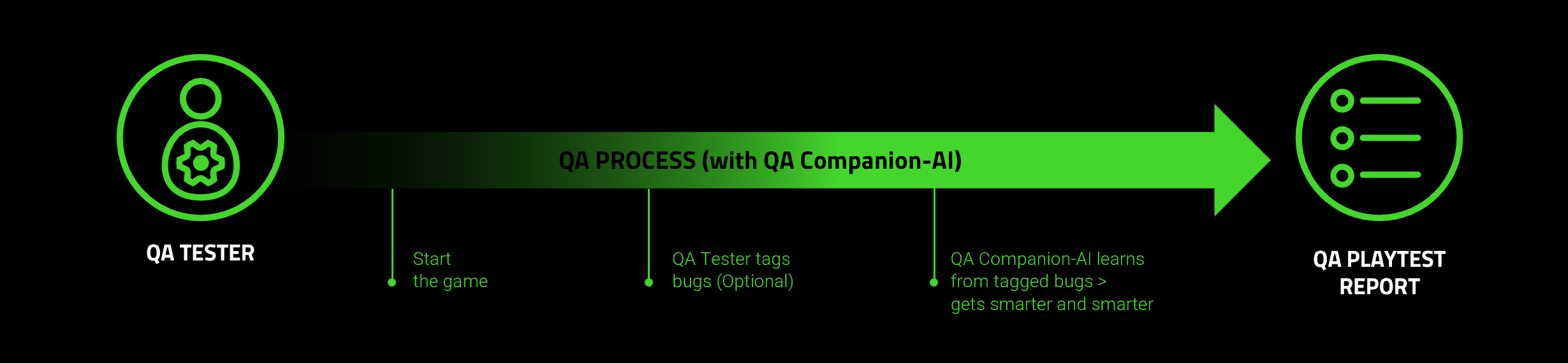
It serves as a companion tool that enhances and supports QA workflow. It automatically captures gameplay context, reduces manual overhead, and ensures QA output is more consistent and actionable. With capabilities like automated crash detection, gameplay bug video capture, and seamless integration with tools such as Jira for game QA bug tracking, it helps teams validate builds faster and with greater confidence.
It exists because the challenges described above are no longer edge cases. They are the norm across modern game development.
It serves as a companion tool that enhances and supports QA workflow. It automatically captures gameplay context, reduces manual overhead, and ensures QA output is more consistent and actionable. With capabilities like automated crash detection, gameplay bug video capture, and seamless integration with tools such as Jira for game QA bug tracking, it helps teams validate builds faster and with greater confidence.
It exists because the challenges described above are no longer edge cases. They are the norm across modern game development.
What’s Next: Practical QA Workflows for Modern Game Teams
Next, we’ll move from observation to execution, focusing on practical QA workflows and processes that help teams manage the complexity of modern games. We’ll examine how AI-assisted and automated game testing, combined with real-time gameplay analysis, can be introduced into everyday production, from early development through late-stage builds, without requiring teams to rethink their entire pipeline.
The goal isn’t disruption. It’s understanding where an AI compan for QA meaningfully improves signal, and where human judgment remains essential. That balance is what enables steady improvement: less ambiguity, clearer feedback for engineering, and higher-quality builds that teams can move forward with confidence.
Quality is no longer just about finding bugs.
It’s about detecting the right gameplay issues, at the right time, with the right context, and turning that insight into action across production workflows.
The goal isn’t disruption. It’s understanding where an AI compan for QA meaningfully improves signal, and where human judgment remains essential. That balance is what enables steady improvement: less ambiguity, clearer feedback for engineering, and higher-quality builds that teams can move forward with confidence.
Quality is no longer just about finding bugs.
It’s about detecting the right gameplay issues, at the right time, with the right context, and turning that insight into action across production workflows.
Sergio Schiavo, Technical Account Manager