MPEG Haptics is Here: The "MP3 Moment" for Digital Touch
Detjon Brahimaj · · Haptic Technology
Haptics has evolved rapidly, from basic vibrations to rich, high-definition tactile experiences powering games, XR, and beyond. The next step is scale. With the release of MPEG haptics (ISO/IEC 23090-31), touch becomes a true media format: standardized, streamable, and interoperable across devices.
Haptics as a First-Order Media Type
For the last decade, the haptics industry has faced a "Tower of Babel" problem. If a developer wanted to make a user feel a heartbeat in VR, they had to write one code for a game controller, another for a haptic vest, and a third for a glove. The result? Fragmentation. Most developers simply gave up, leaving us with basic, non-immersive buzzes.
But as we predicted in our previous coverage, the solution was coming. Now, it has arrived.
Just as audio and video became standardized and interoperable, haptics, the science of touch, is now poised to join them as a first-order media type. This transformation is being driven by the Motion Picture Experts Group (MPEG), the same organization behind the MP3 and AAC audio formats. At the heart of this revolution is WYVRN, whose encoding architecture has been selected as the foundation for the new MPEG Haptics standard.
The MPEG Haptics Standard (ISO/IEC 23090-31) is officially here, and it is doing for touch what the MP3 did for music: creating a universal file that plays everywhere. And this isn't just theory, the Presence Project has already deployed it, proving that the dream of the "Tactile Internet" is now a technical reality.
The MPEG Haptics Standard: A Technical Breakthrough
What is MPEG Haptics?
MPEG Haptics is a new standard for the representation, coding, and delivery of haptic data. Published in January 2025 as ISO/IEC 23090-31, it unifies the encoding of both vibrotactile (vibration-based) and kinesthetic (force and motion) data. This means that, for the first time, haptic effects can be stored, transmitted, and rendered alongside audio and video in a standardized way, just like any other media track in an MPEG file.
Why Standardization Matters
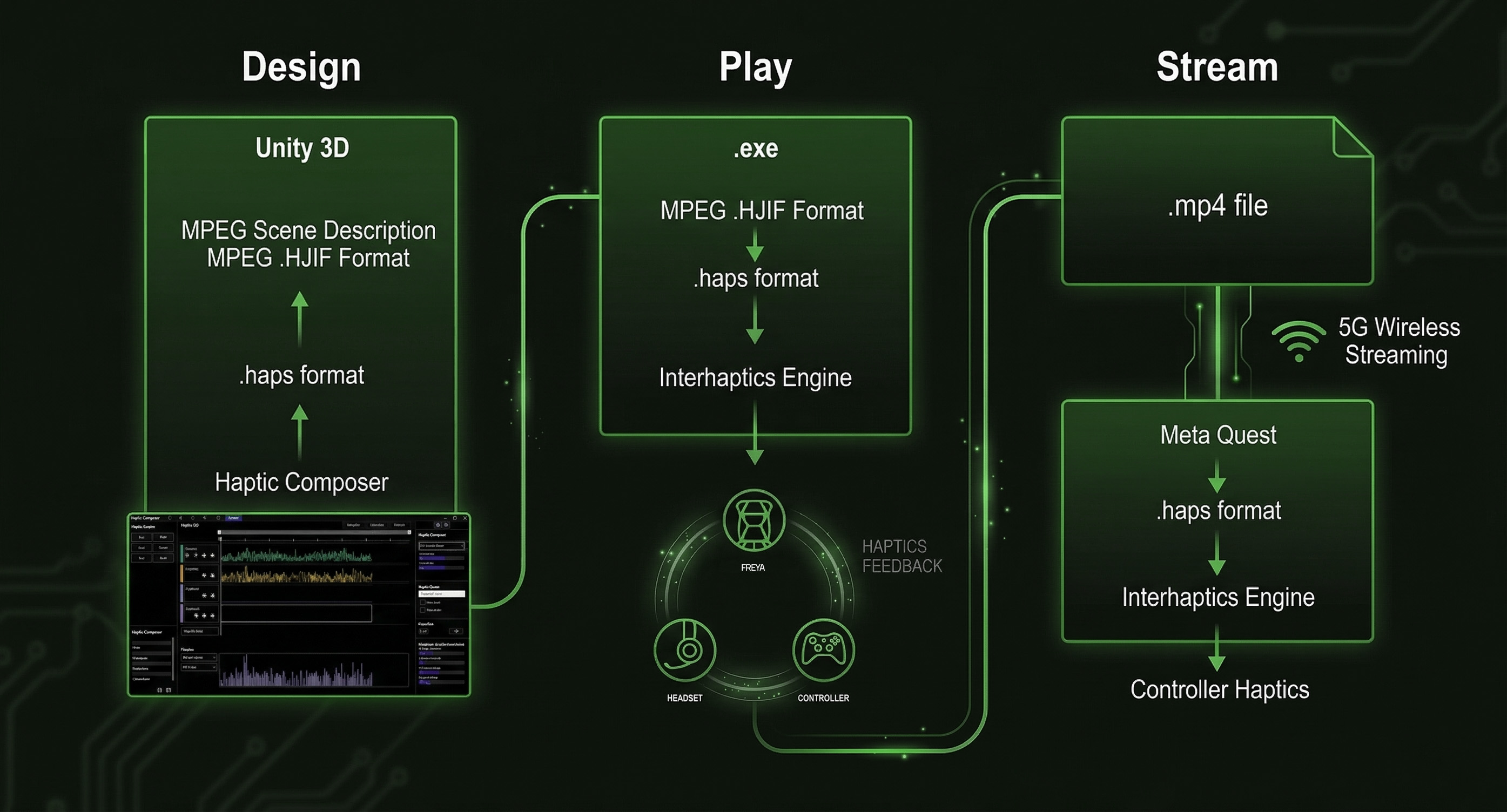
Before MPEG Haptics, the haptics market was fragmented. Each device or platform used its own proprietary format, making it difficult for developers to create cross-platform experiences. The new standard changes this by providing a common language for haptics, enabling interoperability across devices: from smartphones and game controllers to advanced haptic vests, cushions and gloves.
Key Features of the Standard
- Dual Representation: Supports both descriptive (parametric) and signal-based (PCM) haptic data, allowing for both high-level effects and precise waveform controlmpeg.expert.
- Lightweight and Efficient: Haptic tracks can be as small as 8kbps, making them easy to integrate into existing media streams without significant overhead.
- Interoperability: Any device implementing the standard can decode and adapt haptic data, ensuring consistent experiences across platforms.
- Future-Proof: The standard is designed to evolve, with plans to integrate interactive haptics, avatars, and object-based touch interactions in future phases.
WYVRN: Leading the Charge
WYVRN technology was chosen by MPEG as the reference for the new standard due to its superior perceptual performance and compression efficiency. The company’s encoding architecture enables haptic signals to be stored and delivered with minimal loss of quality, making it ideal for everything from mobile gaming to professional VR training.
Tools for Adoption
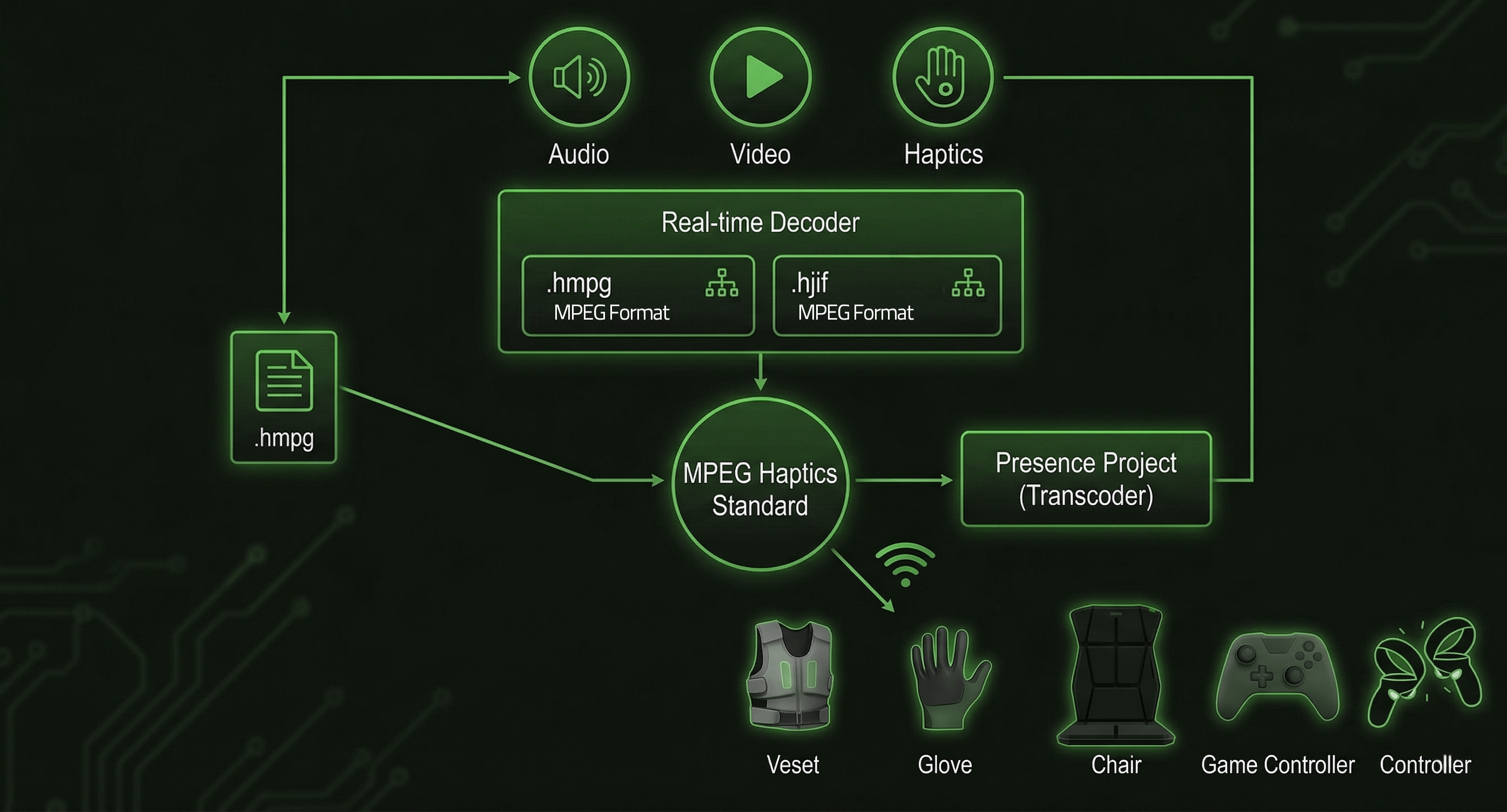
WYVRN provides a suite of tools to help developers and content creators adopt the new standard:
- Haptic Composer: Allows creators to design standard-compliant haptic assets.
- Haptics SDK: Enables rapid integration of haptics into applications, with support for Unity, Unreal and other platforms.
- Reference Software: Open-source implementations are available on GitHub, ensuring transparency and ease of integration.
Industry Adoption: Presence and the Haptic SDK
One of the most exciting examples of MPEG Haptics in action is Presence’s adoption of the standard in their Haptic SDK [Why Haptics Standards Matter — And How PRESENCE Is Making Them Real – XR Presence Project]. Presence is a project dedicated to revolutionizing human interactions in virtual environments by enhancing the concept of presence in eXtended Reality (XR) experiences through innovative technologies and interdisciplinary research. Presence has integrated MPEG Haptics into their development tools, allowing creators to build haptics-enabled applications that work seamlessly across a wide range of devices.
Presence faced a massive integration challenge. They needed to create a single XR environment that supported three radically different devices: Haptic Gloves (Nova 2 from SenseGlove), Haptic Vest, controllers and the Razer Freyja Haptic Cushion.
The "Presence" Implementation: Instead of building three separate integrations, Presence adopted the MPEG .hjif format as the universal language.
In their architecture, the content engine sends a single standard MPEG signal. The Presence Haptics SDK then acts as a dynamic transcoder. It intercepts the MPEG signal and performs a real-time "handshake" with the connected hardware using the standard's Device Interface Layer:
- If the user wears a haptic vest, the SDK maps the signal’s spatial data to the vest's actuators (20+ in this case).
- If the user holds a SenseGlove, the SDK extracts the Kinesthetic perception layer from the same file to apply resistance to the fingers.
- If the user uses Razer Freyja, Razer Kraken V4 Pro, Razer Wolverine V3 Pro or Meta Quest controllers, the SDK renders the signal as HD haptics vibration.
This is the first real-world confirmation that ISO/IEC 23090-31 functions as a "write once, feel everywhere" solution.
This move is significant for several reasons:
- Cross-Platform Compatibility: Developers can now create haptic experiences that work on any device supporting the MPEG standard, from smartphones to high-end VR systems.
- Streamlined Development: The SDK abstracts much of the complexity, enabling creators to focus on designing compelling tactile experiences rather than worrying about compatibility.
- Future-Ready: By adopting the standard early, Presence is positioning itself at the forefront of the next wave of immersive media.
The Road Ahead: What’s Next for MPEG Haptics?
The publication of ISO/IEC 23090-31 is just the beginning. MPEG is already working on the next phase, which will include:
- Interactive Haptics: Enabling real-time, two-way tactile interactions, such as those needed for teleoperation and advanced XR applications.
- Object-Based Haptics: Allowing for the creation of haptic objects and scenes, where users can feel and interact with virtual objects in a more natural way.
- Integration with Other Standards: Ensuring haptics work seamlessly with MPEG-I immersive audio, video, and 3D graphics standards.
Why This Matters for Everyone
For end users, the impact of MPEG Haptics will be profound. Imagine:
- Gaming: Feeling the recoil of a virtual gun, the texture of a virtual surface, or the impact of a collision: all with the same fidelity as visual and audio effects.
- Virtual Reality: Training simulations that not only look and sound real but also feel real, enhancing learning and retention.
- Accessibility: New ways for people with visual or auditory impairments to interact with digital content through touch.
- Remote Collaboration: The ability to “feel” objects or gestures in virtual meetings, making remote work more immersive and effective.
Conclusion: A New Era of Sensory Media
The standardization of haptics by MPEG, with Wyvrn at its core, marks a turning point in how we experience digital content. By elevating haptics to the same status as audio and video, MPEG is enabling a new era of sensory-rich, immersive media. Companies like Presence are already leading the way, demonstrating the practical benefits of the standard and paving the path for widespread adoption.
As the ecosystem grows, we can expect to see haptics become as ubiquitous as sound and vision in our digital lives. The future of media is not just something we see and hear, it’s something we can feel.
Useful links
MPEG Haptics Reference software: GitHub - MPEGGroup/HapticReferenceSoftware
MPEG Haptics publication: Adding Touch to Immersive Media: An Overview of the MPEG Haptics Coding Standard
MPEG 140: MPEG-I Part 31 — Haptics Coding
Detjon Brahimaj, Senior Software Engineer