Haptic Streaming: The Rise of Touch as a Streamable Medium
Admin Wyvrn · · Haptic Technology
Touch is the last missing sense in digital media. While audio and video stream effortlessly across platforms, haptics remains locked inside local devices and proprietary systems. This article explores why touch is technically more complex than sound and visuals, what’s preventing it from scaling, and how emerging standards like MPEG-I are transforming haptics into a truly streamable medium—opening the door to synchronized, networked, multisensory experiences.
Why Haptics Matter: What Touch Adds Beyond Audio and Video
Touch is how humans instinctively understand the world—by pressing, sensing resistance, and receiving confirmation without needing to look or listen. It can reassure, signal success, or communicate danger instantly. In digital environments, haptics restores this fundamental feedback loop, adding presence without distraction or explanation. Where sound and visuals inform, touch confirms, turning digital interactions from something we observe into something we physically feel.
The Evolution of Haptics: From Notification Buzzes to Expressive Touch
For years, haptics was treated as a utility: a buzz to notify, not a medium to design. That changed when developers began shaping touch as part of the experience, using timing, frequency, intensity, and texture to convey intent, interaction, and even emotion. Advances in actuators, authoring tools, and early standardization efforts turned haptics into an expressive design layer rather than an afterthought.
Today, high-quality tactile experiences are possible across many interactive systems—but they are mostly built for runtime execution, not distribution. The next step is no longer about expressiveness. It’s about making touch portable.
Why Haptics Is Technically More Complex Than Audio and Video
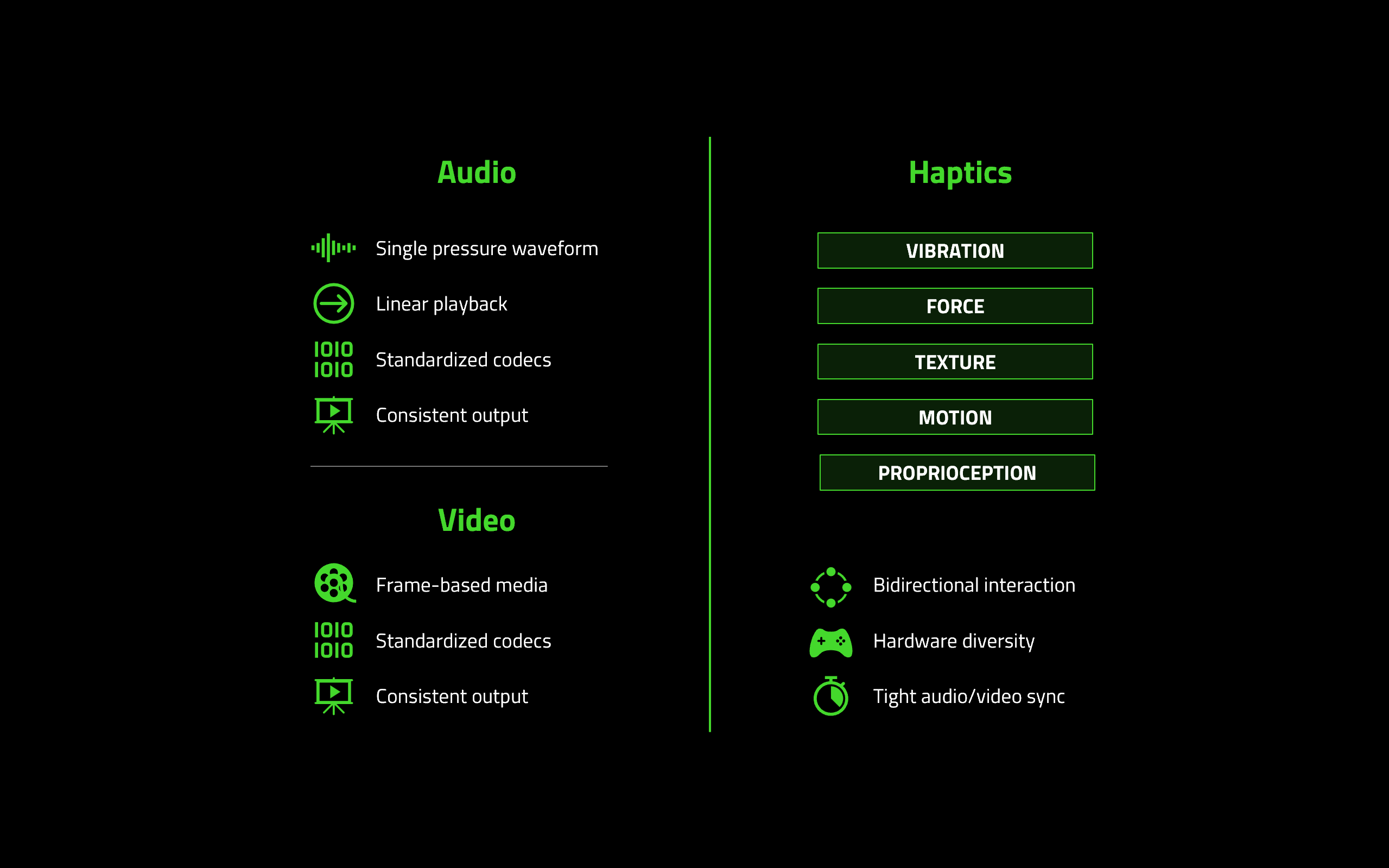
But touch is inherently more complex than audio or video. Sound can be reduced to pressure waves, and video to light captured in frames; both can be encoded in consistent, well-understood formats.
Touch, however, combines multiple physical and perceptual dimensions at once: vibration, force, texture, motion, and proprioception. It engages different receptors across the body, each with unique sensitivity and response. Perception also varies by location: fingertips, for example, can detect micro-vibrations, while other areas barely register them.
Touch is also bidirectional. The user pushes, changes force and alters the feedback loop in real time. This means haptic rendering is not passive playback — it is dynamic interaction.
Hardware diversity adds another layer of complexity. Devices range from simple vibration motors to multi-actuator gloves and immersive systems, each with distinct mechanical capabilities. Delivering consistent tactile intent across such variation is a multisensory and physically constrained challenge.
And because touch must line up with what you see and hear, even small timing errors can break immersion. Precision isn’t optional—it’s fundamental.
How Haptics is Implemented in Modern Games Today
In games, haptics is usually authored as predefined effects triggered by events and mapped to specific devices. Done well, this produces refined, tightly synchronized feedback inside a controlled environment.
The limitation is structural: these effects are tightly coupled to specific hardware and platform APIs and executed inside the game engine. That makes them excellent for local execution—but difficult to travel across networks, platforms, and hardware without a shared encoding standard.
Platforms such as WYVRN are advancing device-agnostic authoring, enabling developers to design touch once and adapt it dynamically across hardware at runtime. And advance solutions, such as Adaptive Immersive Experience, can further augment authored effects with a dynamic context-aware sensory layer operating in real time, keeping immersion perceptually balanced in complex environments.
Yet, despite these advances, touch rarely survives the transition to streamed environments.
The Missing Layer in Modern Streaming
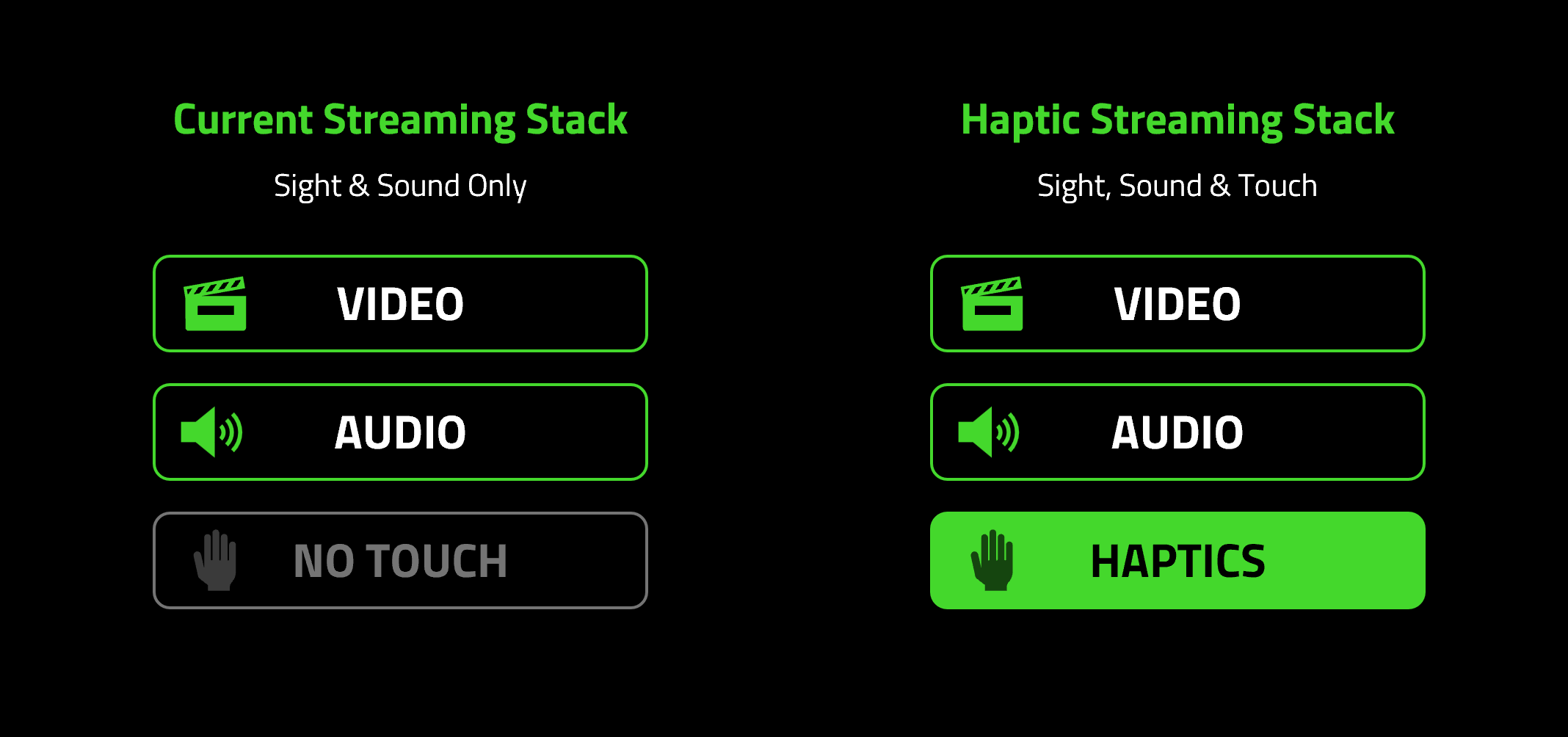
Modern streaming infrastructures—whether for gaming, live events, film, or creator platforms— all rely on audio and video delivery pipelines that simply do not account for tactile data. The result is a growing disconnect: experiences become visually and sonically richer, yet physically incomplete.
The issue is not a lack of interest in haptics. It’s the absence of a standardized, scalable framework to encode, synchronize, and transmit touch as part of the media stream. Until haptics can travel with the content itself, it remains anchored to local hardware — powerful in isolated contexts, but missing from networked experiences. That’s why the next step is synchronization, distribution, and real-time streaming.
What Is Haptic Streaming?
Haptic streaming is the delivery of touch sensation over the network, in the same way we already deliver sound and visuals: captured, encoded into a portable format, transmitted efficiently and rendered consistently across devices.
Instead of relying on custom firmware, device-specific formats, or proprietary pipelines, haptic streaming treat touch as a first-class media type that can be distributed using standard channels like web players, apps or cloud platforms.
To stream haptics, we start by capturing tactile data from physical interactions, authoring tools such as the Haptic Composer, or game events. This tactile data is encoded into a compact, device-agnostic format (not raw actuator commands!). The encoded stream is then transmitted alongside audio and video using conventional protocols and later reconstructed on the user’s device by a haptic engine that converts high-level intent into actuator-specific output, adapted to each device’s capabilities.
The goal is that haptics should not require special drivers, custom SDKs, or parallel file formats. Instead, it should flow seamlessly using the same delivery mechanisms as any other media asset. This is crucial for adoption: creators publish once, platforms integrate once, and every compliant device can render the experience. That removes the friction that has historically fragmented the ecosystem.
For haptic streaming to scale in real-world distribution, three constraints become critical: low latency, precise synchronization, and signal fidelity. If timing slips, immersion instantly breaks. If encoding is poor, the haptics quality degrades. And without scalability, touch can’t become as universal as sound and visuals.
Why MPEG Matters for Haptic Streaming
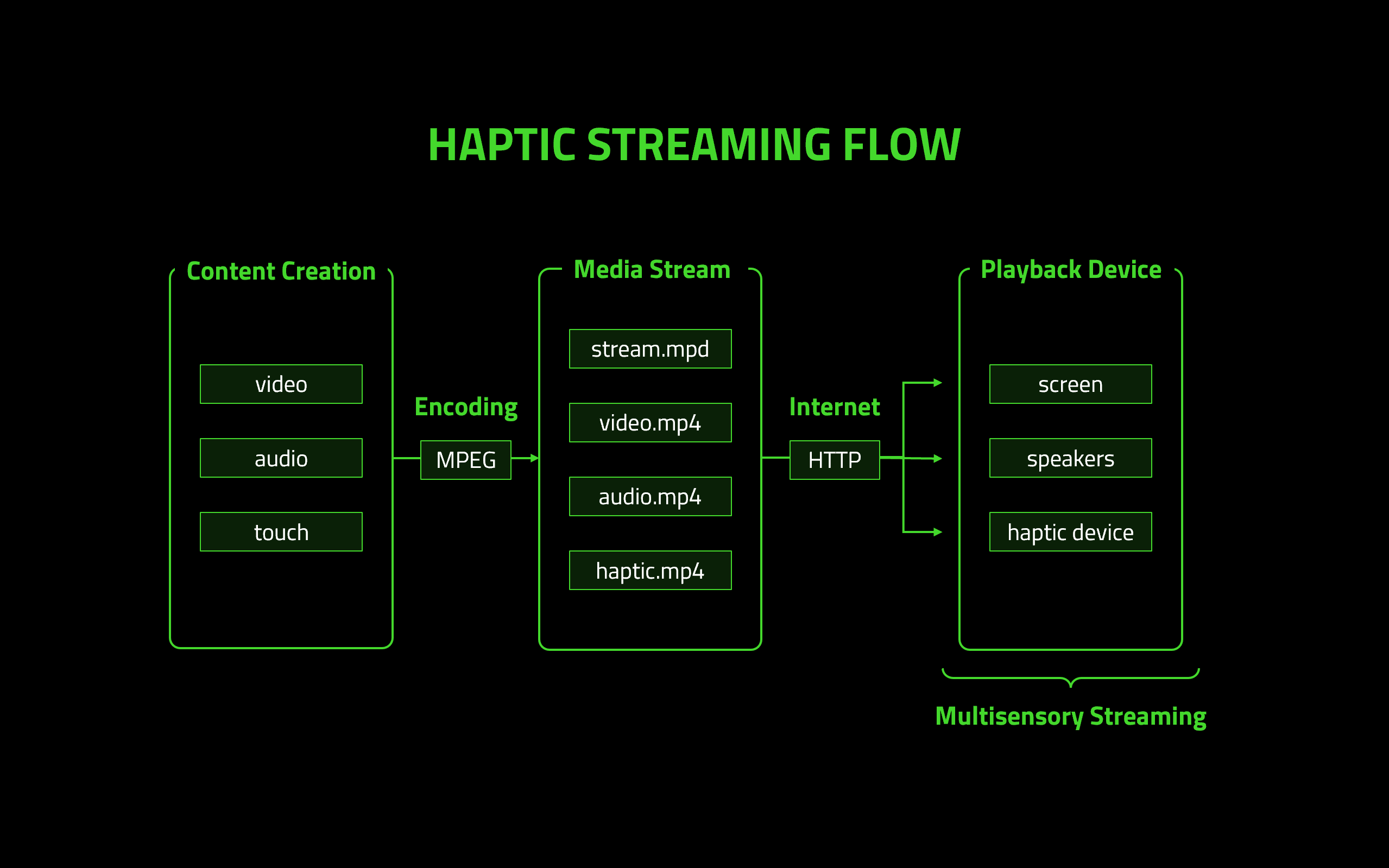
For haptics to scale beyond isolated hardware ecosystems, it needs what audio and video have relied on for decades: a shared, device-agnostic language. That is the role of MPEG-I Part 31 (ISO/IEC 23090-31) — the international standard defining how haptic data is represented, encoded, and understood across platforms.
MPEG introduces a structured and interoperable framework for tactile media. The standard supports both descriptive (parametric) effects — high-level tactile events defined in JSON — and PCM-based inputs representing time-sampled vibration or force waveforms. These can be expressed in HJIF (Haptic JSON Interchange Format), a human-readable representation, or MIHS (MPEG-I Haptic Stream), a binary packetized format optimized for transport.
Just as importantly, MPEG defines how haptic signals can be synchronized precisely with audio and visual streams, ensuring that touch becomes a native part of delivery rather than an add-on.
WYVRN, alongside InterDigital and academic partners, has actively contributed to the development of this framework. We developed a one-way transcoder that converts our native HD Haptic format (.haps) into MPEG-compatible representations, enabling interoperability between authored effects and the emerging standardized pipeline. Our next step is enabling Haptic Composer to export MPEG-compatible files natively, embedding standard compliance directly into the creative workflow.
This matters as devices and platforms continue to evolve. A controller, glove, wearable, XR headset, or automotive surface can receive the same encoded stream and interpret it according to its actuator capabilities. Content can be authored once and remain adaptable as new hardware categories, streaming models, and immersive platforms emerge.
By providing a globally governed standard, MPEG reduces vendor lock-in, protects long-term content investment, and ensures that haptic experiences remain compatible across expanding ecosystems. Haptic streaming cannot scale without this layer of interoperability. MPEG doesn’t just optimize delivery—it makes touch durable and capable of evolving as a streamable media format.
Challenges Ahead for Haptic Streaming
Significant work remains.
Technical challenges:
Technical challenges:
- Ultralow latency: Touch requires <20–30 ms to sync with audio/visuals; network jitter quickly breaks realism.
- Expressive, efficient codecs: We need standardized, high-fidelity formats that compress well and work across devices—this is why MPEG adoption matters.
- Reliable multisensory sync: Even tiny intensity mismatches between touch, sound, and visuals feel wrong.
Ecosystem challenges:
- Fragmented hardware: No common baseline—phones, controllers, gloves, suits all differ dramatically.
- Lack of standards adoption: No universal haptics codec, API, or consistent terminology across platforms.
- Weak creation tools: Content authors lack intuitive editors, preview systems, and debugging tools —plus native export to standard formats (hmpeg, hjif).
- Limited consumer adoption: Advanced haptic devices aren’t widely available or affordable, limiting content incentives.
- Missing platform integration: OS-level, browser-level, and engine-level support is inconsistent or absent.
None of these challenges, however, are fundamental problems, but addressable engineering and ecosystem coordination issues that will mature through continued standardization and alignment—just as audio and video once did.
The Haptics Excellence Center Vision: Building the Infrastructure for Scale
This is why a dedicated Haptics Excellence Center is needed now: to remove the structural barriers that keep haptics fragmented, local, and device-bound. By focusing first on standardized encoding, synchronization, and streaming of haptic data alongside audio and video, the Center targets the problems that block adoption across platforms and ecosystems. Its role is uniquely cross-cutting, bridging research, standards, and real-world implementation.
At scale, this would allow platforms to distribute video, audio, and haptics together. A live gaming stream could deliver synchronized tactile feedback to viewers. Game publishers could release multisensory trailers that audiences can physically feel. Device makers could immediately access a broad ecosystem of compatible content without bespoke integrations. And this is only the start.
In that future, touch is no longer an enhancement layered on top of digital media. It becomes a native component of how all content is delivered and experienced.