From Static Vibes to Moving Sensations: How Spatialized HD Haptics Redefines Immersion
Detjon Brahimaj · · Haptic Technology
What makes haptics feel like real movement instead of just vibration? This article explores how spatialized HD haptics creates directional, body-traveling sensations across cushions, chairs, and wearables, turning tactile feedback into a new layer of immersive game feel.

Immersion isn’t just what you see or hear, it’s what you feel. Spatialized haptics transforms vibration from a flat buzz into motion that travels across your body, creating a sense of presence no screen can match. One of the most powerful techniques in tactile design is spatialization: making vibrations feel like they move across your body, even though the actuators themselves are fixed. This illusion of motion is what turns simple vibrations into dynamic, directional experiences.
Spatialized haptics map tactile energy in space and time so you feel not only that something happened—but where it happened and how it moved. With Razer Sensa™ HD Haptics, you get multidirectional control, ultralow latency responsiveness, and harmonized effects across multiple devices, all in sync with audio and visuals.
What “Spatialized” Means in Practice
Spatialization in haptics is the process of creating apparent movement by controlling how and when actuators fire. It refers to shaping where and how feedback is felt: left versus right, high versus low, near versus far, moving or anchored.
On a cushion, this can manifest as rising sequences from the seat to the shoulders, arcs wrapping around the torso, or fixed, pinpoint sensations. Unlike audio, which naturally propagates through space, haptics requires deliberate control of actuator timing to create the illusion of motion.
By carefully sequencing discrete points of contact, we can trick the brain into perceiving continuous trajectories: left to right, front to back, or even spiraling. These patterns can be auto-generated from sound through audio-to-haptics mapping, while game-specific integrations allow precise, authored experiences.
How It Works
Human perception integrates timing and intensity cues to infer motion. If two actuators fire close enough in time, the brain assumes continuity. This is similar to how audio panning creates the illusion of a sound moving across speakers. In haptics, the effect is tactile and far more visceral. When combined with directional patterns, spatialization transforms static feedback into kinesthetic storytelling.
Real-World Examples
These effects aren’t just cosmetic, they enhance proprioception, reinforce spatial context and awareness, and increase emotional engagement, making interactions feel physically meaningful.
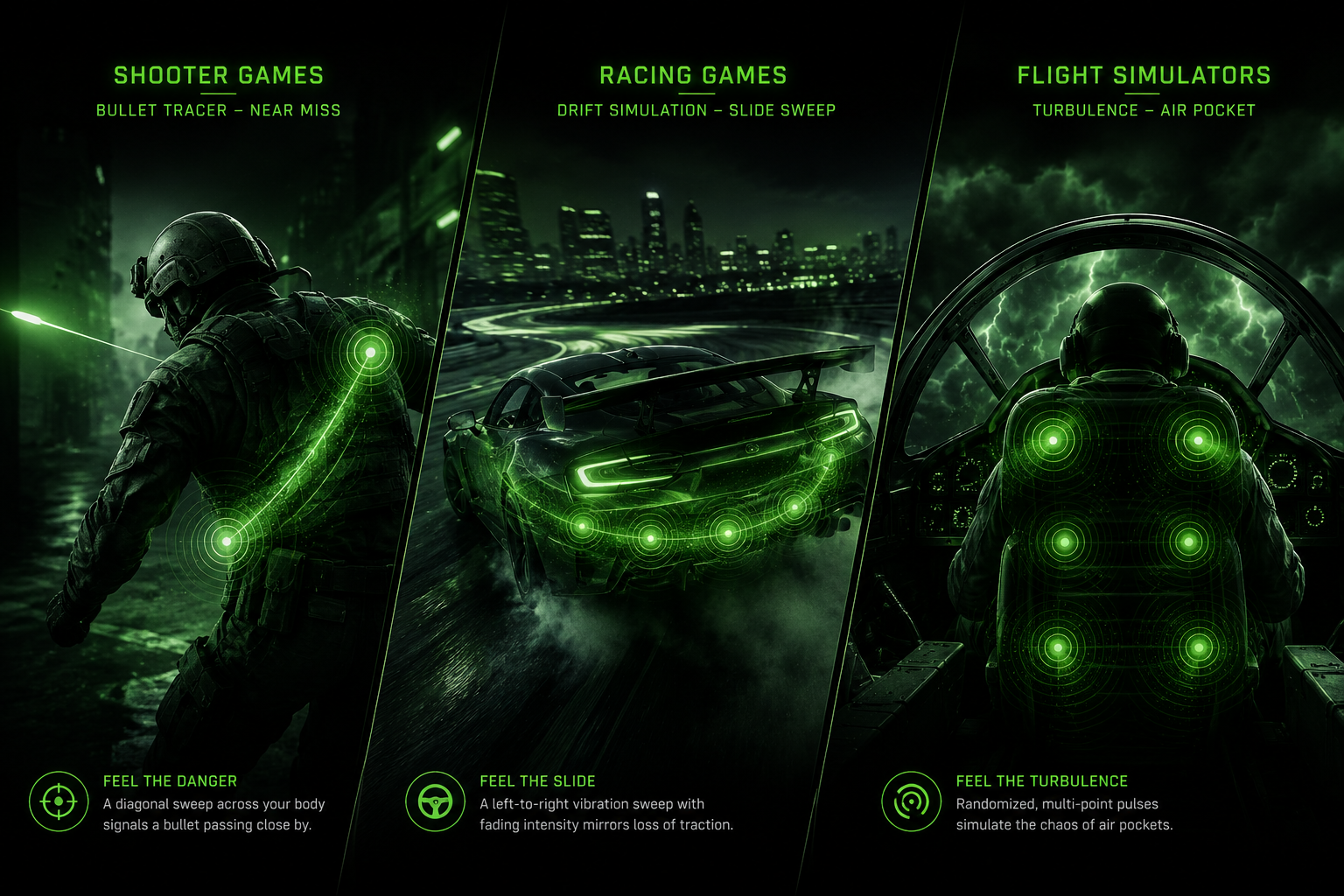
Shooter Games:
- Explosion Shockwave: A ripple starting at the spine and expanding outward simulates a blast wave, enhancing urgency and immersion.
- Bullet Tracer: A quick diagonal sweep across the chest can mimic a near-miss projectile, improving spatial awareness.
Racing Games:
- Drift Simulation: A car sliding on gravel can feel like it’s sweeping under your seat by activating actuators from left to right with decreasing intensity, mimicking friction loss.
- Acceleration Feedback: A forward surge can be represented by a front-to-back vibration ramp, reinforcing speed and momentum.
Flight Simulators:
- Turbulence: Randomized spatialized vibrations across the seat create a convincing sense of instability.
- Engine Thrust: Continuous low-frequency vibration at the back transitioning forward during takeoff reinforces directional force.
The Core Principles
There are three main techniques behind convincing haptic motion:
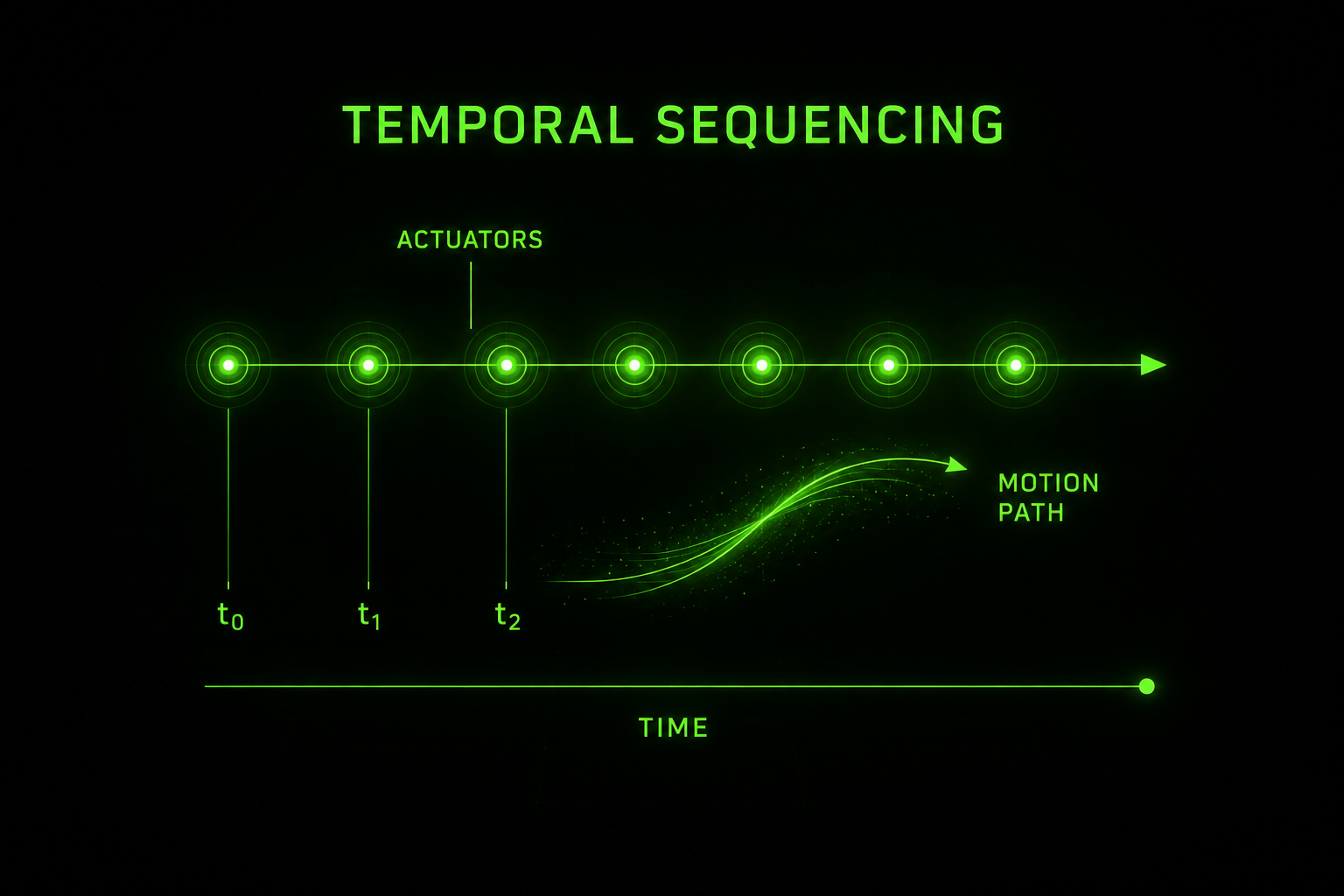
Temporal Sequencing
Actuators are triggered in rapid succession, with millisecond offsets. For example, to simulate a sweep from your lower back to your shoulders, we fire actuators in ascending order with precise timing. The brain stitches these pulses into a single moving sensation.
Actuators are triggered in rapid succession, with millisecond offsets. For example, to simulate a sweep from your lower back to your shoulders, we fire actuators in ascending order with precise timing. The brain stitches these pulses into a single moving sensation.
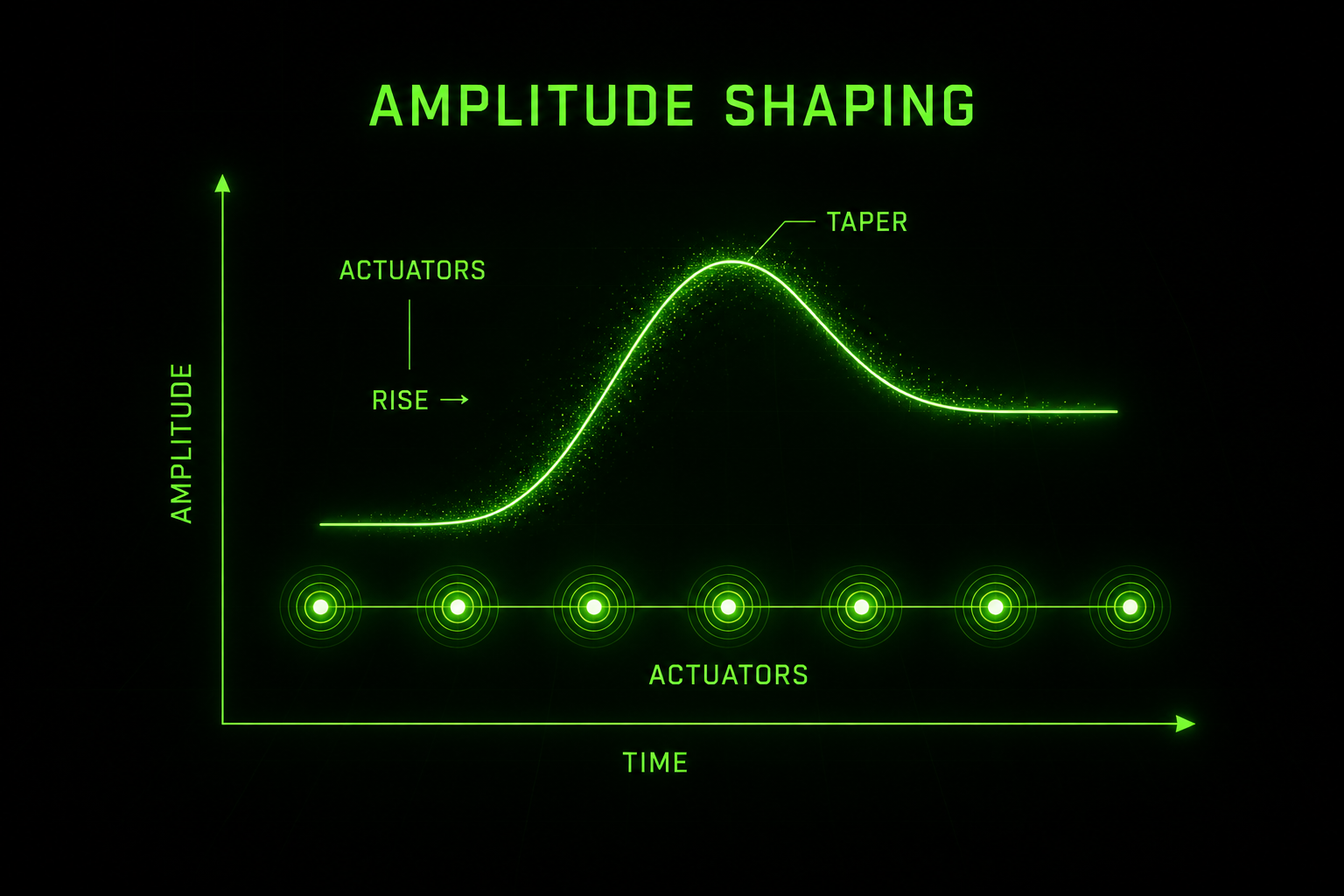
Amplitude Shaping
Intensity isn’t static. By ramping amplitude up or down across the sequence, we mimic acceleration or deceleration. A rising curve feels like something approaching; a tapering curve feels like it’s fading away.
Intensity isn’t static. By ramping amplitude up or down across the sequence, we mimic acceleration or deceleration. A rising curve feels like something approaching; a tapering curve feels like it’s fading away.
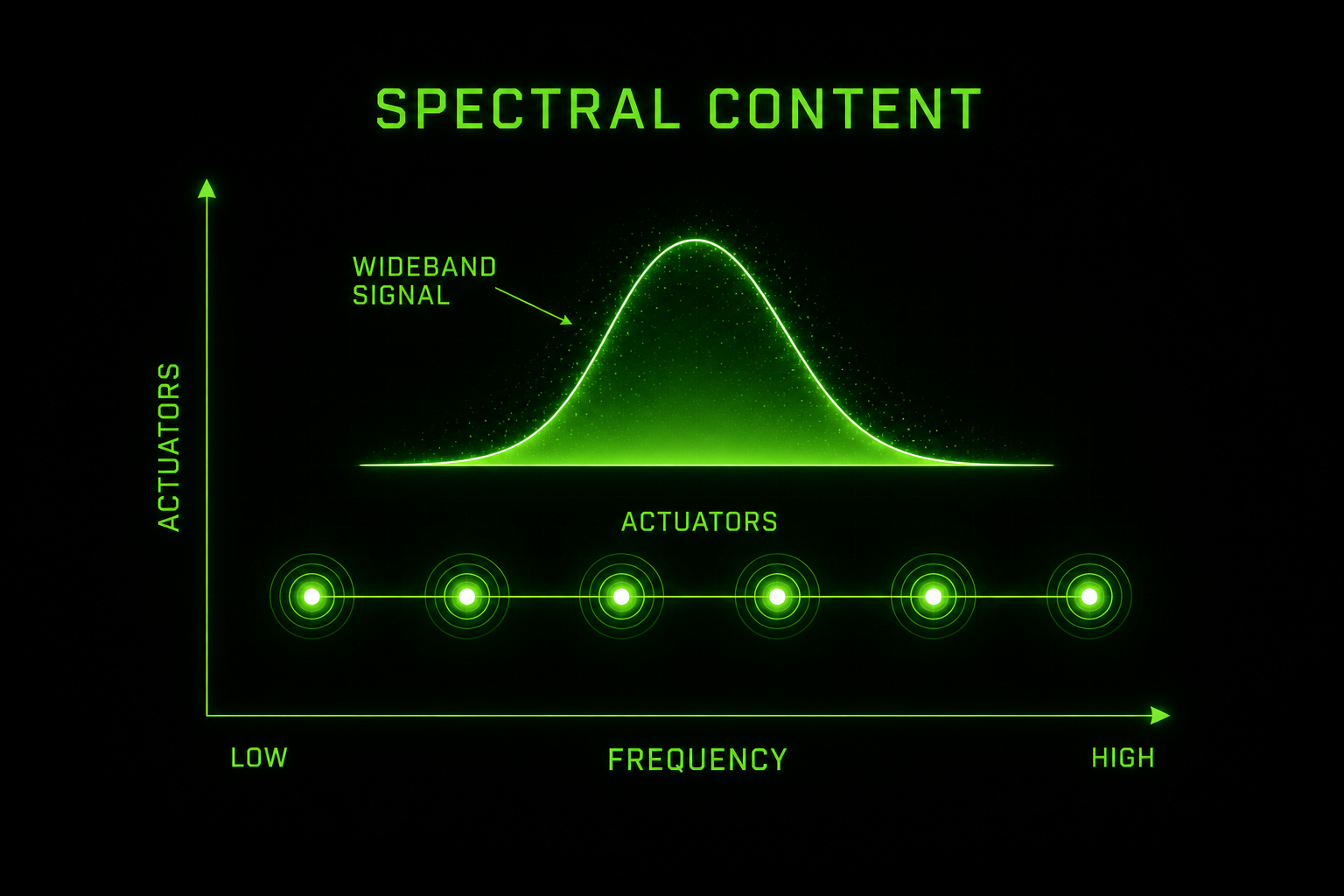
Spectral Content
Wideband haptics, signals with rich frequency content, add texture and realism. A low-frequency rumble feels heavy and grounded, while adding mid-frequency components can make the motion feel sharper or more energetic.
Wideband haptics, signals with rich frequency content, add texture and realism. A low-frequency rumble feels heavy and grounded, while adding mid-frequency components can make the motion feel sharper or more energetic.
Developer Workflow
Through the WYVRN SDK, developers can script spatial effects without reinventing the wheel. Instead of manually timing each actuator, they define paths and curves: “enemy approaching from rear-left” becomes a trajectory mapped to actuators with dynamic envelopes. This abstraction accelerates iteration and ensures consistency across devices like cushions, chairs, and headsets.
Curious on how to create spatialized effects? Check out this blogpost.
Curious on how to create spatialized effects? Check out this blogpost.
The Future of Haptic Motion
We’re exploring AI-driven spatial orchestration, where models learn which patterns feel most natural for different contexts and player profiles. Imagine adaptive sweeps that adjust speed and intensity based on gameplay tension or user sensitivity. The goal isn’t just more vibration, it’s meaningful motion, tuned to narrative and emotion.
Want to feel the future of gaming? Explore Razer Sensa HD Haptics and experience motion that moves you.
Detjon Brahimaj, Senior Software Engineer