Beyond Pixels: How the WYVRN Ecosystem Orchestrates Total Sensory Immersion
Detjon Brahimaj · · WYVRN Ecosystem
Graphics alone can’t make games feel real. The WYVRN Immersive Ecosystem synchronizes Sensa HD Haptics, THX Spatial Audio+, and Chroma RGB into one cohesive sensory layer—so every explosion, footstep, and shockwave is heard, seen, and felt in perfect lockstep.
Gaming immersion has long been a tug-of-war between graphical fidelity and visceral feeling. We have pushed frames, pixel density, and ray-traced reflections to their absolute limits, yet there is a threshold where better graphics stop making the experience feel more "real."
The missing link isn't better-looking pixels; it is multisensory coherence.
True immersion happens when touch, sound, and light reinforce a single in-game event simultaneously. This is the philosophy behind the WYVRN Immersive Ecosystem, a synchronized fusion of Sensa HD Haptics, THX Spatial Audio+, and Chroma RGB. It transforms gaming from something you watch into an orchestrated moment you can hear, see, and feel in your body.
The missing link isn't better-looking pixels; it is multisensory coherence.
True immersion happens when touch, sound, and light reinforce a single in-game event simultaneously. This is the philosophy behind the WYVRN Immersive Ecosystem, a synchronized fusion of Sensa HD Haptics, THX Spatial Audio+, and Chroma RGB. It transforms gaming from something you watch into an orchestrated moment you can hear, see, and feel in your body.
The Trinity of Immersion
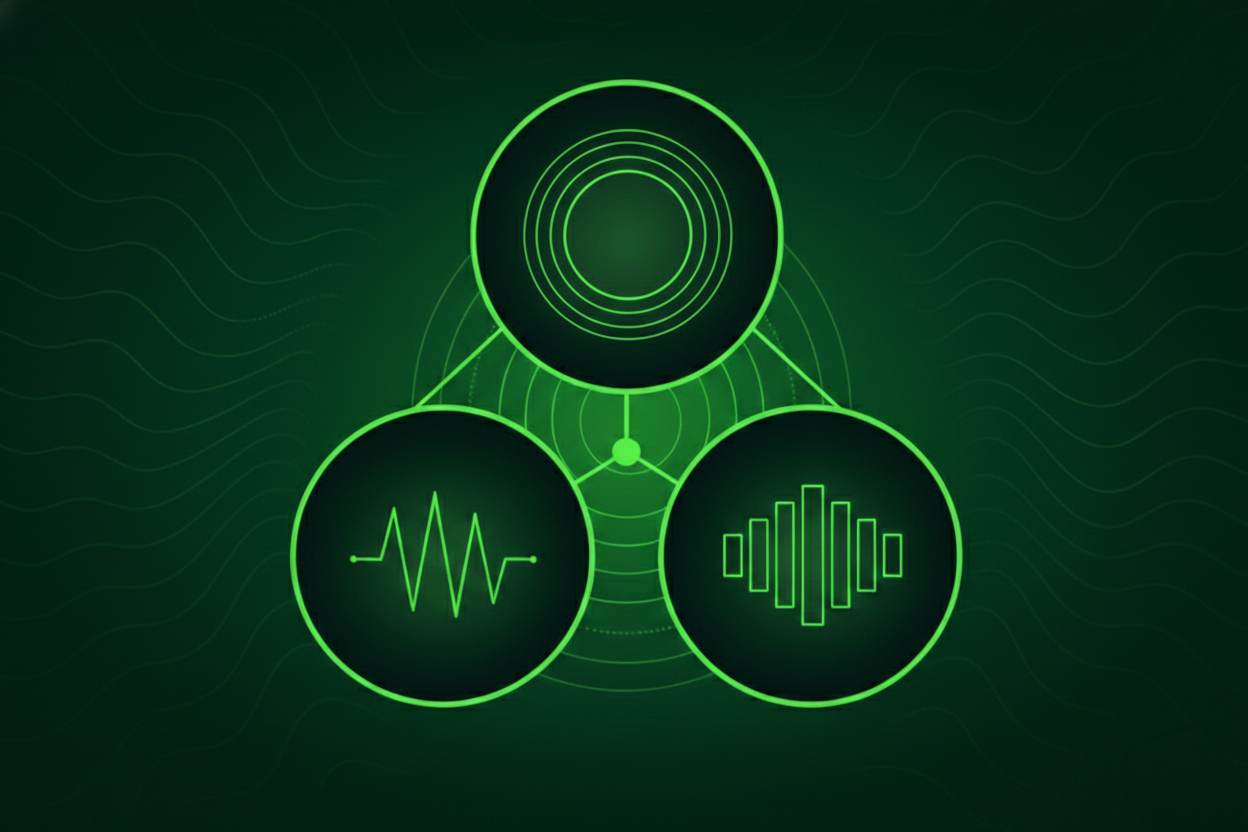
The WYVRN Ecosystem doesn't just run three technologies in parallel; it forces them to speak the same language.
- Sensa HD Haptics: Wideband, low-latency and spatial tactile feedback.
- THX Spatial Audio+: 3D auditory spatial positioning.
- Chroma RGB: Ambient lighting visual synchronization.
When a footfall moves from the rear-left to the front-right of your character, it isn't just a sound effect. With WYVRN, Sensa mirrors that motion with a distinct tactile arc across actuators, while Chroma RGB aligns color and intensity to the same timeline. This cross-modal reinforcement makes gameplay events easier to perceive and significantly more emotionally resonant.
Sensa HD Haptics: The Backbone of "Feeling"
At the core of this ecosystem is Sensa HD Haptics, a platform designed to move beyond simple static vibrations, replacing the binary on/off state of traditional rumble with a high-fidelity, wideband signal. By utilizing a broader frequency range, the platform delivers directional, definition-rich touch that mimics real-world physics rather than just vibrating a controller.
The platform’s true power lies in Multi-Device Spatialization (The "Bloom" Effect). Sensa treats connected devices as a single canvas. A distinct haptic event can traverse the user's body—sweeping from the lumbar region of a cushion to the cranial drivers of a headset—mirroring the trajectory of in-game objects.
The platform’s true power lies in Multi-Device Spatialization (The "Bloom" Effect). Sensa treats connected devices as a single canvas. A distinct haptic event can traverse the user's body—sweeping from the lumbar region of a cushion to the cranial drivers of a headset—mirroring the trajectory of in-game objects.
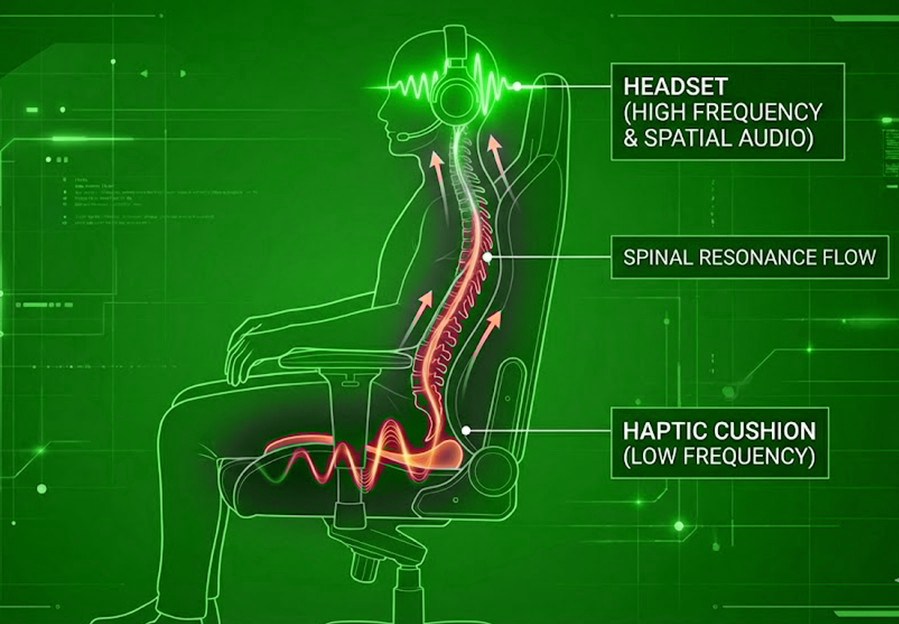
This is achieved with sub-20ms latency. By synchronizing tactile feedback perfectly with the render pipeline, Sensa ensures that visual, auditory, and haptic cues hit the player’s senses simultaneously, eliminating the cognitive dissonance caused by lag.
THX Spatial Audio+: The Soundstage of Reality
THX Spatial Audio+ Plugin brings professional 7.1.4 spatial audio rendering directly into the developer workflow. Integrated with Wwise, it gives audio teams precise control over height channels, virtual speaker layout, and environmental acoustics, enabling accurate object placement and fully spherical sound design within interactive game worlds. The result isn’t just technical fidelity, but perceptual realism: players can intuit room dimensions, judge enemy distance, and understand environmental geometry in real time—tracking movement, anticipating threats, and reacting to off-screen action across a true 360° sound field.
Chroma RGB: Expanding the Canvas
Chroma RGB is no longer just about pretty lights; it is an atmospheric extension of the game engine. With the new Automatic Content-Aware Mapping, AI analyzes on-screen action to project a "3D light canvas" across your entire room, synchronizing not just your peripherals but also compatible smart lights (Govee, Nanoleaf, Philips Hue). This moves lighting from a 2D desktop reaction to a spatial experience where a flashbang doesn't just turn your keyboard white, it floods your peripheral vision with blinding light, perfectly matching the intensity and decay of the in-game event.
A Unified Workflow for Developers
For studios, the goal isn't just spectacle; it’s about a sustainable workflow. Previously, integrating haptics, light, and sound required "spaghetti code" integration that was difficult to maintain.
The WYVRN SDK changes this by allowing studios to offload sensory composition.
The WYVRN SDK changes this by allowing studios to offload sensory composition.
- Tag Events: Developers simply tag in-game events.
- External Authoring: RGB animations, spatial cues, and haptic effects are authored and iterated outside the game engine.
- Unified Triggering: The boss slam, the shockwave, and the light pulse are triggered via a single interface.
This ensures that the audio-visual-tactile loop stays in perfect lockstep without burdening the game's core code.
Reality Check: Shipping Today
This multi-sensory layer isn't theoretical vaporware. It is shipping right now in devices like the Razer Freyja (HD haptic cushion) and Kraken V4 Pro (HD haptic headset).
Reviewers are already noting the distinct shift in experience. The sensation of impacts "cascading around" the body—particularly in mech simulations and racing titles—offers a level of presence that standard peripherals simply cannot match.
Reviewers have called out the unique feeling of impacts 'cascading around' the body when haptics are harmonized across endpoints — Tom's Hardware Review
Reviewers are already noting the distinct shift in experience. The sensation of impacts "cascading around" the body—particularly in mech simulations and racing titles—offers a level of presence that standard peripherals simply cannot match.
Reviewers have called out the unique feeling of impacts 'cascading around' the body when haptics are harmonized across endpoints — Tom's Hardware Review
The Future: AI-Driven Orchestration
Looking forward, we are moving toward AI-driven sensory orchestration. We are exploring models capable of learning player preference, arousal levels, and context to dynamically tune spatial audio and haptic trajectories in real-time.
The ultimate goal is to create consistent "presence" without sensory fatigue, bringing the high production values of cinematic sound design into the realm of tactile storytelling.
With the WYVRN Immersive Ecosystem, immersion is no longer just a set of features on a box. It’s a cohesive system, and it is here to change how we play.
The ultimate goal is to create consistent "presence" without sensory fatigue, bringing the high production values of cinematic sound design into the realm of tactile storytelling.
With the WYVRN Immersive Ecosystem, immersion is no longer just a set of features on a box. It’s a cohesive system, and it is here to change how we play.
Detjon Brahimaj, Senior Software Engineer